


A Decade of Delight: How Mischief Theatre's 'The Play That Goes Wrong' Conquered the West End and Beyond
Lyn Gardner Catches Up with Henry Lewis, Jonathan Sayer and Henry Shields as the Show Celebrates 10 Years in the West End

This week Mischief Theatre Company’s The Play That Goes Wrong celebrates its 10th birthday in the West End. Mischief is a David that has conquered the Goliath of the West End and brought joy to many thousands of people. But why did their tiny fringe show become such a phenomenon, and has the journey always been non-stop laughs?
Even its creators—Henry Lewis, Jonathan Sayer, and Henry Shields—say it is a question that slightly drives them mad, and who can blame them? If there was a magic formula that could be copied, everyone would be able to crack the West End, and they don’t. Even big-shot producers like Sonia Friedman sometimes have duds.
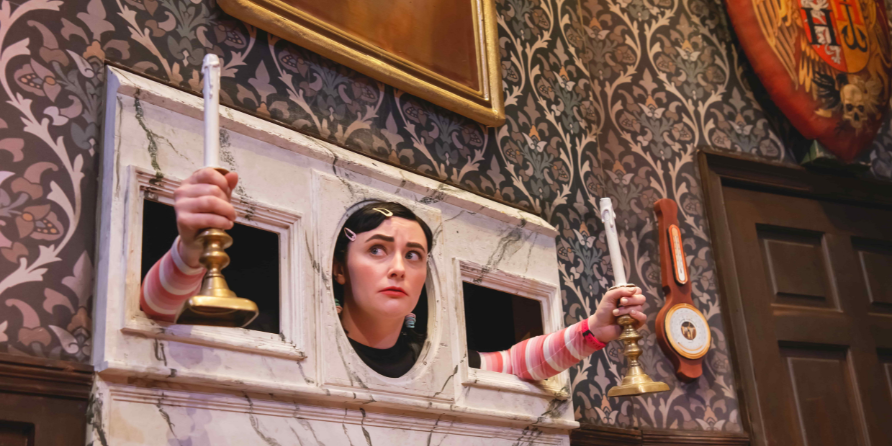 The current cast of The Play That Goes Wrong, photo by Matt Crockett.
But when the former LAMDA students first wrote the show, there were no guarantees that it would go on to be the mega success that it has. The Play That Goes Wrong has been seen in over 45 countries around the world (“the response is the same in whatever language it is in,” says Sayer) on British TV, and it is the longest running comedy in the West End. It has spawned several successful offshoots, including Peter Pan That Goes Wrong, The Comedy About a Bank Robbery, and Magic That Goes Wrong. As Tim Bano observed in the Stage back in 2019, the Mischief brand is the closest UK theatre has to a franchise. One that could yet run and run.
The truth, of course, is that it is not just talent, hard work, and a darn good show that create a West End hit, but multiple factors. So, it is not surprising the trio all have different theories why The Play That Goes Wrong has lasted so long.
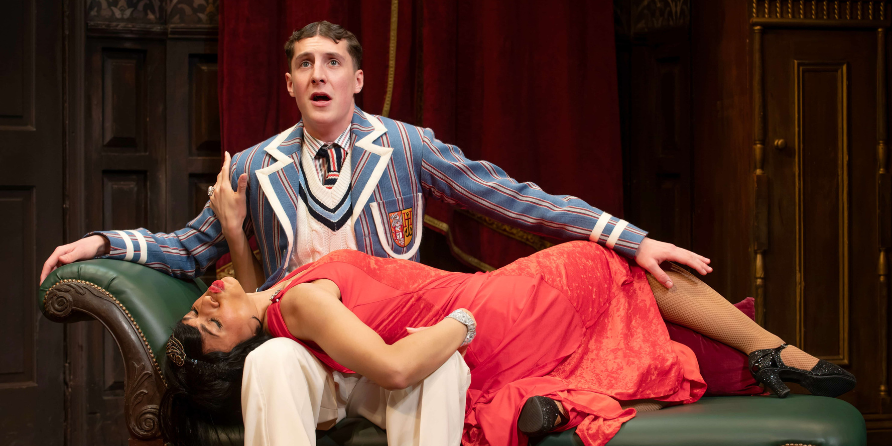 The current cast of The Play That Goes Wrong, photo by Matt Crockett.
Sayer reckons that it could just have been a fortuitous case of being in the right place at the right time, and because the show appeals to all ages, whole families can go together and create memories, and that has helped it become a lasting word-of-mouth success. Lewis says its irreverence has wide appeal, and the desire to keep ticket prices as low as possible has made it accessible. Then there’s the fact that it is in a 496-seat theatre, which helped it put down roots. “Particularly in the early days when we first went into the West End. If we had been in a 1,000-seat theatre, it would have been far harder to keep going.”
Shields argues that it is just very funny (which it is) and the show’s success was built on “putting in as many jokes as possible. We wanted funny things to happen all the time.” Shields’ theory is that when they were creating The Play That Goes Wrong, theatre still lagged behind TV, which in US shows such as Friends and Frasier had upped the joke quota. “Those shows were trying to make everything funny, and I think what we did was to do that in theatre and just try for as many laughs as possible, and at the time nobody was doing that, so it was something different, almost revolutionary." Even the theatre programme was funny, and to this day the company’s London tube adverts raise a smile on the escalator.
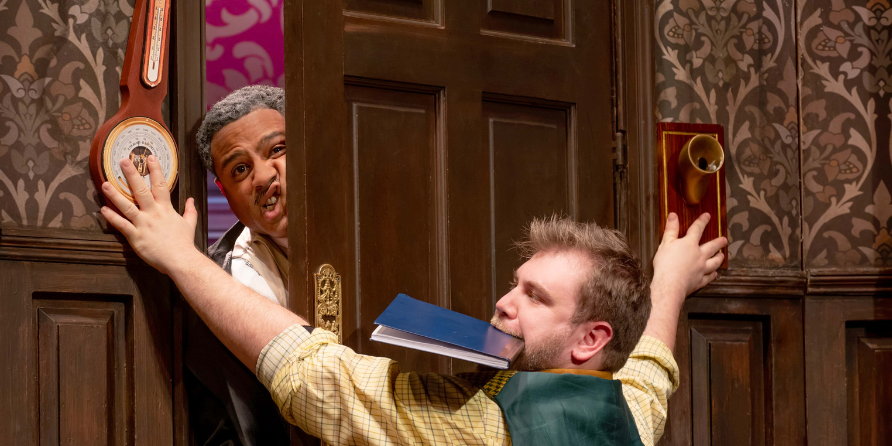 The current cast of The Play That Goes Wrong, photo by Matt Crockett.
But when Lewis, Sayer, and Shields premiered The Play That Goes Wrong in the tiny Old Red Lion in December 2012, they had no reason to believe that they were on the brink of a huge success. Their show wasn’t even the main event. It followed a Korean comedy, which had the main evening slot. They were four years out of drama school and still flipping burgers and working in bars. The trio had been regulars at the Edinburgh fringe with their improv comedy show, but their careers showed little sign of taking off.
Lewis, Sayer, and Shields say that there was no one single moment when they thought they had suddenly cracked the big time.
“We were just a bunch of people who liked working together who were putting on a play and having fun doing it,” recalls Lewis. “There was never a moment when it felt as if the show’s success was inevitable.”
“It was more that we had micro goals,” says Sayer. “When we were at the Old Red Lion, the goal was to be the main show at 7.30, not the second show, and not to have to store our set on the roof. It wasn’t like we were aiming for the West End. Then the producer Kenny Wax came to see the show and said that maybe it could go on a tour. For us, it was quite mind-boggling, the idea of going out on a regional tour of that scale.”
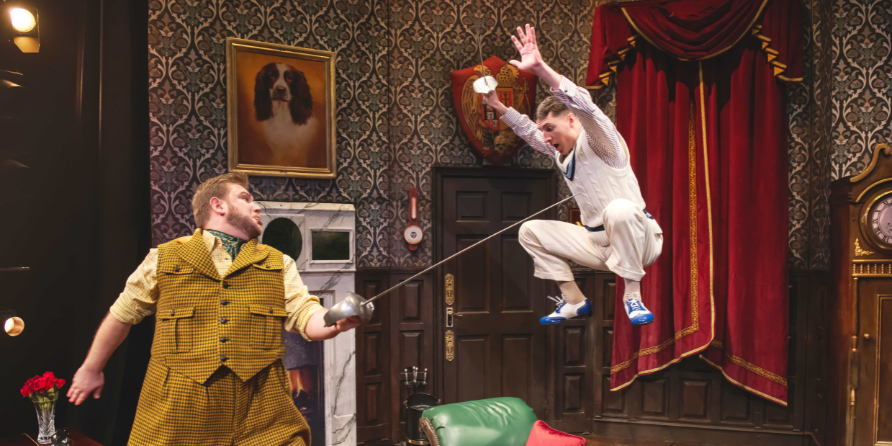 The current cast of The Play That Goes Wrong, photo by Matt Crockett.
“No, we rarely looked very far ahead,” says Lewis, “so everything that happened always felt like a huge step.” One of the highlights was getting a slot to do The Play That Goes Wrong at the Pleasance for the Edinburgh Fringe. For years they had knocked fruitlessly at the door of the Pleasance hoping for a Fringe slot for their improv show, but it was The Play That Goes Wrong that secured them that long-held ambition. “After years of rejection, that felt like an achievement, but then even that was dwarfed when shortly after Edinburgh we were out on tour and played 1,200 people in Canterbury. That was a real shock of success.”
A decade on, and with The Play That Goes Wrong still bringing wild hysteria to the West End, the trio are not resting on their laurels but exploring new ways and methods of making audiences laugh and having a great night out. The process by which they do it is pretty much fundamentally the same as it was when they first started.
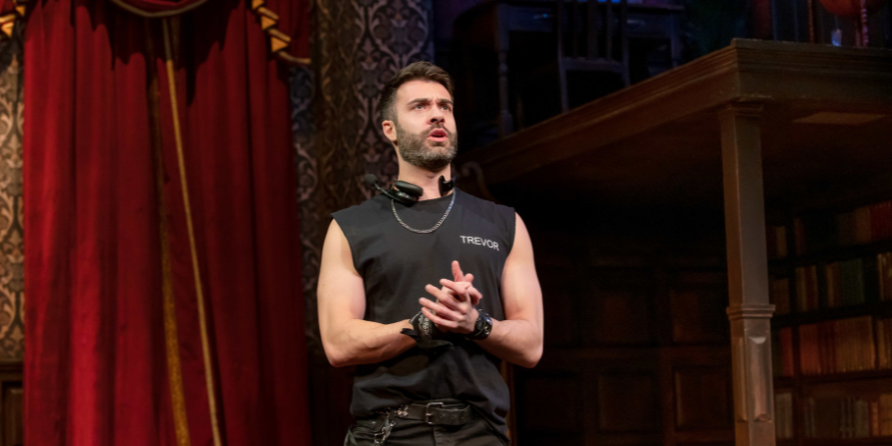 The current cast of The Play That Goes Wrong, photo by Matt Crockett.
“Maybe there is a bit more planning than there was with The Play That Goes Wrong. Some of our more recent stuff, like Bank Robbery and Groan Ups, has had more narrative, and for that, you do have to plan more because you are telling a story. But for us, a really important part of the process is getting the physical comedy up on its feet as soon as possible with the actors, and then we go away and rewrite and then do it again.”
But is it still as fun as it was back in those early days prior to 2012, when they hadn’t yet tasted success?
“Sometimes it can feel more like work now than play. The creative process is always at its most fun for us near the beginning of a project because that’s when you are most creatively free. As you refine it and work out the structure, it can feel less playful. But it still feels fun to do; fun has always been an important part of why we do it.” Fun is key to why The Play That Goes Wrong has been such a success and has spread such a lot of happiness. Mischief clearly knows that those who laugh last, laughs longest.
Cover photo of the original cast from The Play That Goes Wrong, Photo by Alastair Muir. Book your tickets here.


