


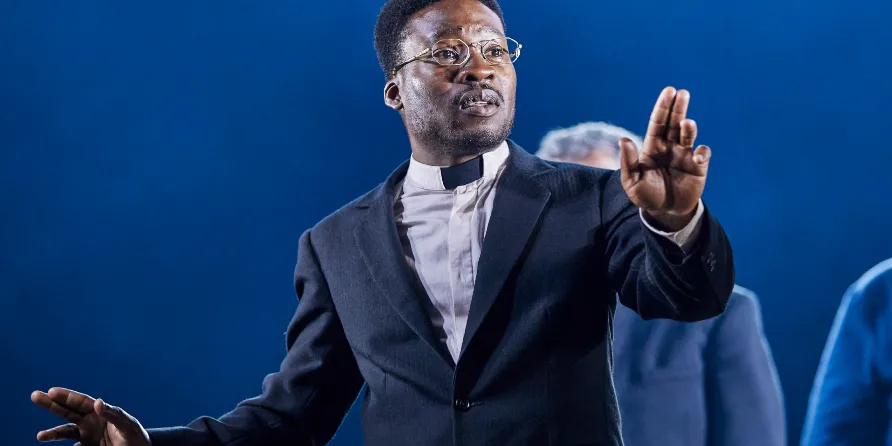
Fisayo Akinade: "I think the purpose is to move people, and if we don’t do that in the theatre, we are not doing our jobs."
Lyn chats with the actor about the importance of the supporting actor, the transfer of Lyndsey Turner’s The Crucible from the National to the West End, and how Arthur Miller's masterpiece remains relevant.

There are some actors who always draw the eye and are capable of breathing life into the smallest role. Fisayo Akinade is one of them. You may know him as Mr. Ajayi in the Netflix series Heartstopper or as Dean Monroe in the C4 Russell T. Davies series Cucumber. He was a glorious, complex Mercutio in the National’s pandemic-filmed version of Romeo and Juliet, with Jessie Buckley and Josh O’Connor as the lovers.
But it is in live performance that Akinade always makes his singular mark. He’s an actor with an eye for detail and a gift for making every character he plays feel as if they are completely crucial to the story and have their own journey to make through it. He was a brilliant Dauphin—petulant in a way that was both comic and sad—in Josie Rourke’s St Joan at the Donmar in 2016, he turned the role of Anthony’s attendant Eros into a highlight of Simon Godwin’s Anthony and Cleopatra at the National in 2018, and he was a lynchpin in the ensemble for Alistair McDowall’s 2022 time-travel fantasy The Glow at the Royal Court.
"I used to want to be the lead," says Akinade, who was born in Liverpool and raised in Manchester, where he got into theatre by going to drop-in drama sessions at Contact Theatre. "But what I’ve realised is that the characters I get cast to play may not drive the story as the main antagonist, but they are there for a reason, and it’s about finding how they fit into the larger narrative, and there are often so many colours to find in these characters. I find them really fascinating."
Always being the bridesmaid but seldom the bride may not suit some actors, and it requires both a lack of ego and a generosity of spirit, but there is no better advertisement and advocate for the crucial importance of the supporting actor than Akinade. He cites Philip Seymour Hoffman’s performance in the movie Charlie Wilson’s War. "Tom Hanks is the star, but Hoffman has just one scene, the best scene in the movie, and he comes in and he nails it and delivers the absolute truth, and then he leaves. I find that so intriguing." Like Hoffman, Akinade is an actor’s actor.
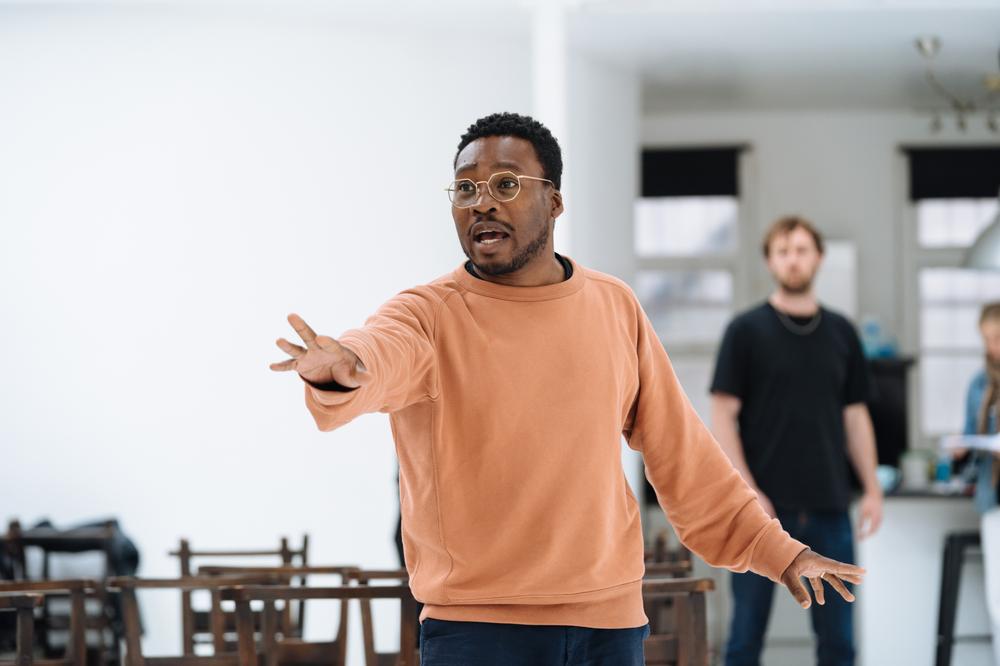
Fisayo Akinade in rehearsals for The Crucible. Photo by Helen Murray.
This summer, there is a chance to see Akinade doing what he does so brilliantly in the transfer of Lyndsey Turner’s The Crucible from the National to the West End. Where it takes up residence at the Gielgud Theatre, Akinade will reprise his role as the Reverend Hale in Arthur Miller’s monumental mid-20th century play set in 17th-century Salem and written in response to the McCarthy trials of 1950s America, which aimed to root out communist sympathisers by getting Americans to turn on and testify against each other. In Miller’s play, teenage Abigail Williams encourages other girls to make accusations of witchcraft against certain townsfolk. Soon nobody is safe, and a stable community collapses amidst fear and hysteria.
The Reverend Hale is, in many ways, the conscience of the play. He begins as a man who believes that the devil must be rooted out of the community, is swept up in the witch hunt, and too late realises that consequences have actions and the legal proceedings are not delivering justice. It’s an absolutely key role of the kind Akinade has proven himself in over and over.
"Hale’s so fascinating to play. His brain is whirring away throughout the play, and suddenly there is the moment when he realises that Abigail is lying and that private vengeance is working through the public testimony. His tragedy is that his vision was blinkered, and too late he realises that life is more important than religion."
Not that Akinade wants us to see any of the mechanics of that. "I’m not a big fan of cerebral acting. I don’t like seeing an actor’s homework on stage or feel as an audience member, that I’m being lectured. I think the purpose is to move people, and if we don’t do that in the theatre, we are not doing our jobs."
Miller rather sadly said that The Crucible was a play that would never become irrelevant because it serves as a warning "of tyranny on the way or a reminder of tyranny just past."
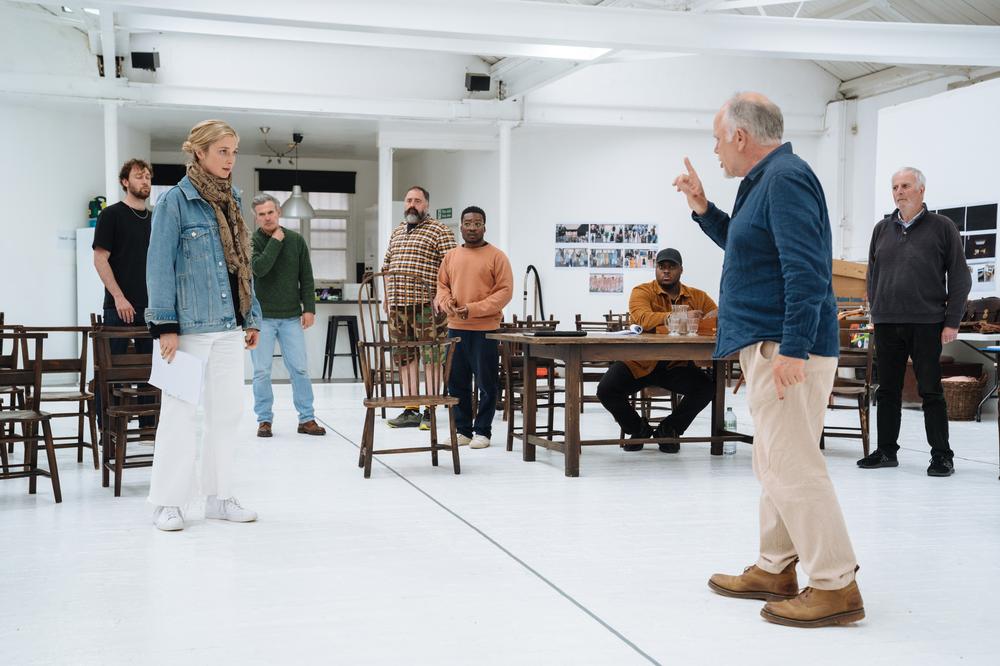
The cast in rehearsals for The Crucible. Photo by Helen Murray.
I ask Akinade why he thinks this particular play speaks to us at this particular moment in time.
"We’re in an age of finger-pointing and blame. I think the play speaks to that, to an age where there is a trial by Twitter and people pile on and the person gets vilified, judged, and, for lack of a better word, cancelled." He cites Ann Putnam in The Crucible, a woman who goes to church, tries to live a good life, but has the misfortune to have lost seven children, and who points the finger at someone else who becomes the target of all her pain, anguish, and anger. "Miller makes it feel so true in the way the play looks at how we use finger-pointing to deal with our own feelings of guilt or shame or how we can look virtuous by pointing out somebody else’s lack of virtue." Which, of course, happens on Twitter all the time.
Akinade splits his time between TV and the theatre and would like to do more of the latter, but says that it is just not financially sustainable.
"I love theatre with every fibre of my being, and the fact you are more in control than in TV and film. On TV and film, your performance is captured, collated, and put into a computer, and edited. Somebody else decides what are your best bits and you have no say or control over it. But theatre is a collaboration. I love that. You, the other actors, the writer, and the director make it together. It’s a constant discovery. I really love that."
Cover image of Fisayo Akinade as Reverend John Hale in The Crucible now playing at The Gielgud Theatre through the 2nd September, 2023. Photo by Brinkhoff-Moegenburg.


