



In praise of Robert Icke’s Oedipus
Lyn Gardner explores Robert Icke's innovative approach to the classic tragedy, blending contemporary themes with timeless drama.

The eagle-eyed amongst you may be wondering about how it is possible to praise a production that hasn’t yet opened. It is true that Robert Icke’s take on the ancient Greek tragedy, starring Mark Strong as Oedipus and Lesley Manville as Jocasta, won’t begin previewing at Wyndham’s Theatre until October 4th. In the meantime, in April, Icke will open his condensed version of Shakespeare’s two Henry IV plays, rechristened Player Kings at the Noël Coward, with 84-year-old Sir Ian McKellen playing Falstaff.
But praise is due because this is the English language premiere of a stunning production that, in its original Dutch-language version, was seen at the Edinburgh International Festival, and for those of us lucky enough to catch it, it was a blinding theatrical experience that remains seared on the retina.
I reckon we can all be really confident that the casting of Strong (last seen on stage at the NT in Icke’s production of The Red Barn, and before that playing another great flawed tragic character, Eddie Carbone in A View from the Bridge) and Manville (so ticklishly fab as Princess Margaret in The Crown) is not going to destabilise Icke’s razor-sharp and contemporary version of Sophocles, which received a full deck of five-star reviews in Edinburgh in 2019. Like the director’s 2015 Oresteia, it offers a version of the play that makes us see it from a startlingly new perspective and brings it fully back to life despite the passage of so many centuries.
 Mark Strong in the 2015 production of A View From The Bridge, photo by Jan Versweyveld.
Icke’s Oedipus is a modern politician in the Obama mould. There are even hints of the Birther Controversy, with his opponents calling for him to show his birth certificate, which, for those familiar with the play, offers an interesting foreshadowing of the catastrophe that will unfold at breakneck speed. But secure in the knowledge that he is on the cusp of a great victory in the polls, this Oedipus is confident in every way, and confident that he knows exactly who he is. The future looks golden and secure. But what is Oedipus refusing to see?
While his campaign headquarters are dismantled around him, he and his family sit down for a celebratory meal. But the landslide that occurs is one that is very different from that predicted, as Oedipus casually starts announcing policies even before his victory is crowned. That includes investigating the mysterious death of the former ruler, Laius, who had been married to Oedipus’ now wife, Jocasta.
What makes this production so full of dread is that we, the audience, already know that he is, as Greek scholar Simon Goldhill has put it so succinctly, “the answer to his own quest.” Just as in Icke’s brilliant Romeo and Juliet and Oresteia, a digital clock counts down the seconds, condensing time in a sickening way, lending ancient Greek tragedy the feel of a contemporary thriller as time runs out for Oedipus and his family.
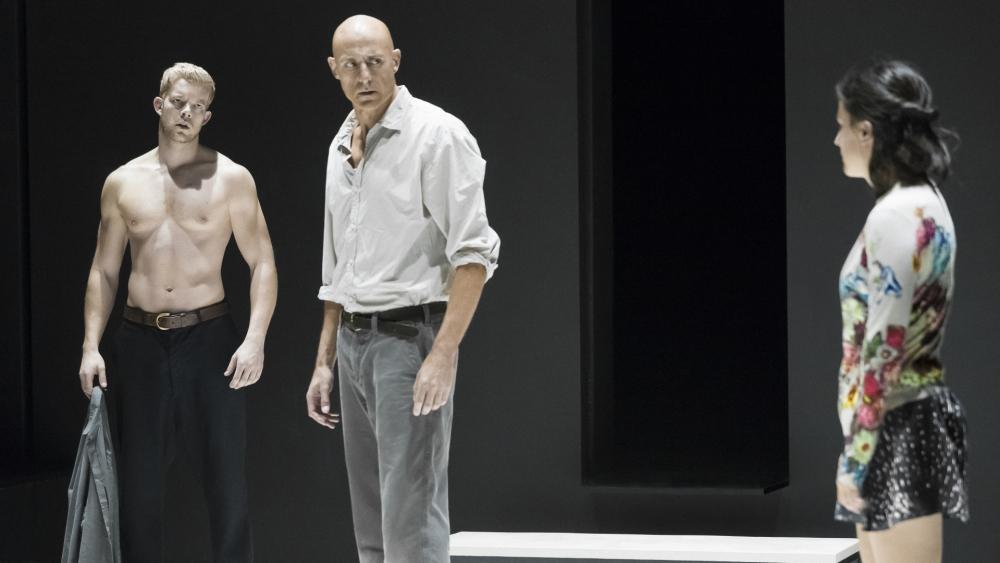
 Robert Icke's 2019 production of Oedipus, at the Kings theatre in Edinburgh, photo by Jane Hobson.
One of the novel things about the production is the way that Icke recasts it not just as the tragedy and fall of one man but as a family tragedy and one that will echo back and forth down the generations. It is much the tragedy of Jocasta, once the abused child bride of Laius, a woman who has already known unbearable loss in her life, as it is of Oedipus’. It is also the tragedy of Oedipus and Jocasta’s bright, shiny children, so confident and confident of their futures. But with the exception of blind Teiresias, who sees what Oedipus cannot or will not, none of us can see the future.
The beauty of Icke’s production is that it cleverly and subtly reminds us what the future holds for this family, including daughter Antigone and her two brothers—the latter bickering at the table over the chicken dinner just as one day they will war with each other over the keys to the kingdom—but it layers the future into the script even as it explores the impossibility of ever really knowing yourself or your own story. Oedipus’ mistake in his moment of triumph is to think that he can control the narrative of his own story.
It is a devastating and salutatory lesson, and one from which Icke wrings maximum dramatic tension and maximum emotion. I can promise you will leave the theatre completely wrung out.
 Lesley Manville and Mark Strong will star in Robert Icke's 2024 production of Oedipus, photo by Joan Marcus.
Interestingly, Icke’s Oedipus won’t be the only opportunity to see a version of Sophocles’ play as 2024 turns into 2025. Within minutes of the announcement of Icke’s production, the Old Vic announced that it too would be staging a new version of the play in early 2025, written by Ella Hickson and starring Bohemian Rhapsody star Rami Malek as Oedipus opposite Indira Varma as Jocasta.
That production is much more of an unknown quantity, but my guess is that two significant but distinct versions of the same play shouldn’t be seen as rivals, but their proximity in programming might actually increase demand rather than diluting the audience because people will be intrigued by the rare opportunity to see two very different approaches from major artists with cracking casts.
I can thoroughly recommend Icke’s version, but I’d lay a bet both will be worth your time, not least because, as Simon Goldhill puts it, Sophocles play “sets a remarkable trap for its audience. It encourages you to be smug in your superior knowledge, but insistently, insidiously reminds you that, like Oedipus, you are not in control of your journey, and the moment when you think you are most secure is the moment at which your self-delusion is most dangerous.”
Opening in October 2024, book your tickets here.


