


Kyoto: The Political Thriller You Can’t Miss
Lyn Gardner catches up with playwrights Joe Murphy and Joe Robertson as Kyoto arrives in the West End

In early December, the Merriam-Webster dictionary declared that “polarisation” was its word of 2024. Joe Murphy, co-founder with Joe Robertson of Good Chance Theatre, the company responsible for Little Amal and the Young Vic/West End hit, The Jungle, which Murphy and Robertson wrote together, reckons it’s a good choice. Perhaps more pertinent than OED’s “brain rot” and Collins’ “brat.”
That may be because Murphy and Robertson are the co-authors of Kyoto, a pacy political thriller set at the 1997 Kyoto climate conference, which arrives at @sohoplace this week after a hugely successful run at the RSC’s Swan Theatre in Stratford-upon-Avon.
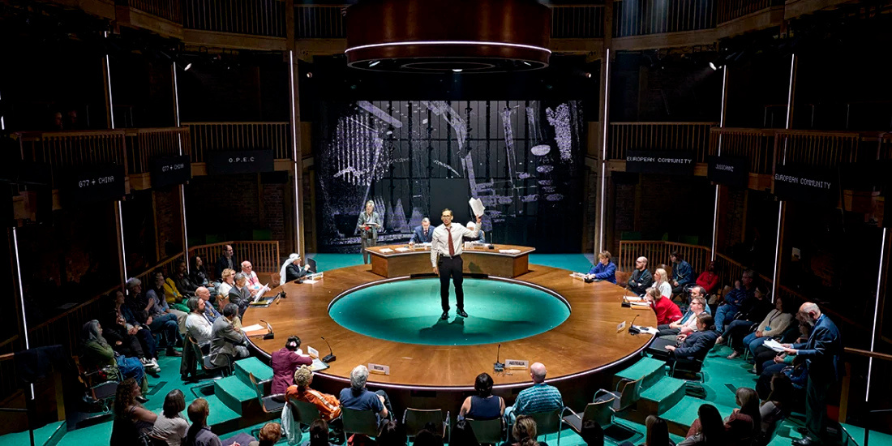 Production photo from Stratford-upon-Avon run.
Murphy reckons that as a society we have fallen into “the habit of disagreement.” He and Robertson want Kyoto—the story of the Kyoto climate agreement, reached against the odds and some nail-biting attempts to derail it by vested interests led by sharp-suited American lawyer, Don Pearlman—to “uplift the idea of agreement and inspire people.” Murphy adds, “Agreement is not a compromise of your individuality, quite the opposite.” In an increasingly polarised world, that’s an idea worth sharing.
As Robertson chips in: “It feels like an important story for now. We are so riven by disagreement. People no longer talk together; they just get more and more angry and polarised. It is getting harder to find zones of agreement and civility in difficult times.”
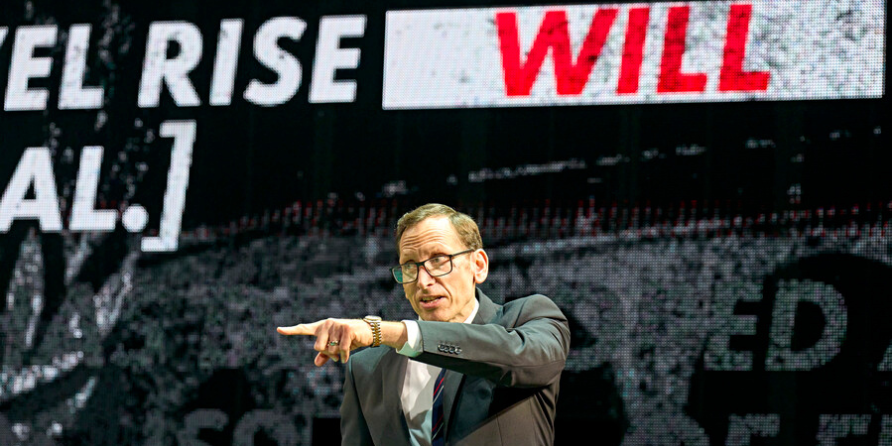 Production photo from Stratford-upon-Avon run.
Good Chance came out of the time spent by Robertson and Murphy in the Calais refugee camp. They didn’t go with the intention of making theatre, but rather to find out about the refugees from 25 countries who were living there. Realising that the camp lacked a cross-cultural space, they set about helping those living in the camp to create one, The Domes. That experience fed into The Jungle, the thrilling play that put the audience at its heart to examine how we might live together despite cultural, religious, and racial differences.
“That question has always been the catalyst for Good Chance’s work,” says Robertson. “We are always exploring how we can bring people together, whether that was the Dome, The Jungle, or Little Amal walking through Europe and meeting people in town squares, people who might never go and sit in a velvet-covered seat in a theatre. It’s why we got obsessed with the story of Kyoto, because it was a moment in history in which 180 countries with very different needs, economies, and cultures came together and unanimously agreed to do something about something as complicated as climate change.”
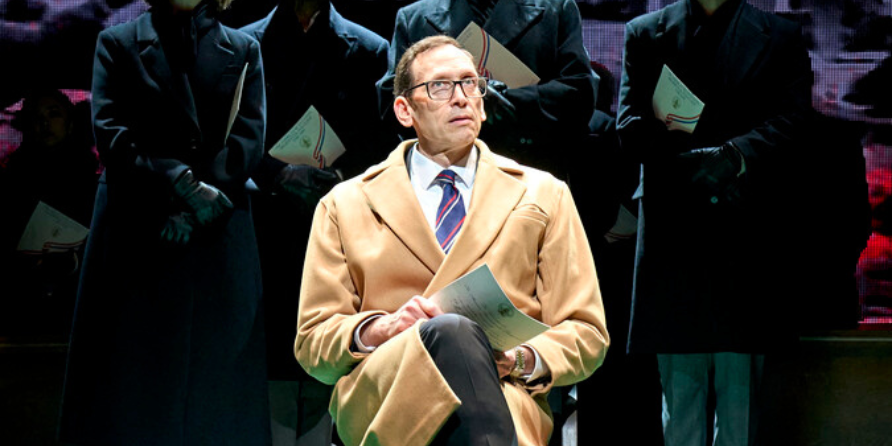 Production photo from Stratford-upon-Avon run.
Kyoto proves it can be done, but almost 30 years on, it feels as if we are a long way from achieving agreement over how to tackle the climate emergency. After all, the most recent COP conference in Baku ended in discord without agreement.
Maybe Kyoto, the play, can be seen as a form of activism that puts the art of storytelling at its heart. In Stratford the play garnered dozens of enthusiastic reviews, but few were more pertinent than the one published in the internationally esteemed science journal, Nature, which argued that the play was heartening for the way it demonstrated how the impossible can become possible. Nature pointed out that “the warnings of climate scientists have been ignored for much too long. Something in the telling needs to change.” Maybe that is the job that Kyoto is doing as it sets up a drama that makes the audience feel the jeopardy and respond with their hearts as well as their brains.
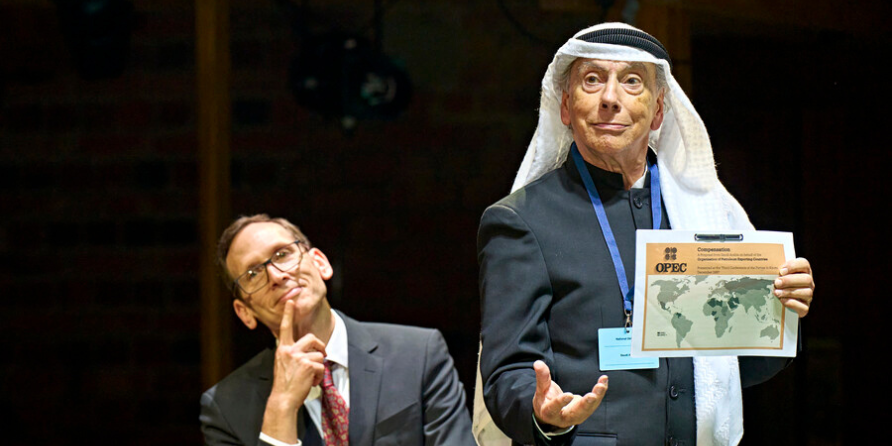 Production photo from Stratford-upon-Avon run.
Robertson says that unlike journalism, whose job is to report on what happens at the COP conferences, theatre can make audiences feel too, and “that’s the role of art.” He says you can ignore a news story about a climate conference, but Kyoto sweeps audiences up in the drama of what is happening in the conference room.
“It’s a political thriller and one that has an anti-hero at its heart, so audiences are genuinely gripped. It takes them with it, and so they understand what is at stake.”
A note in the program at the Stratford performances made the point that the euphoria of what occurred at Kyoto was short-lived as countries once more fell back into disagreement.
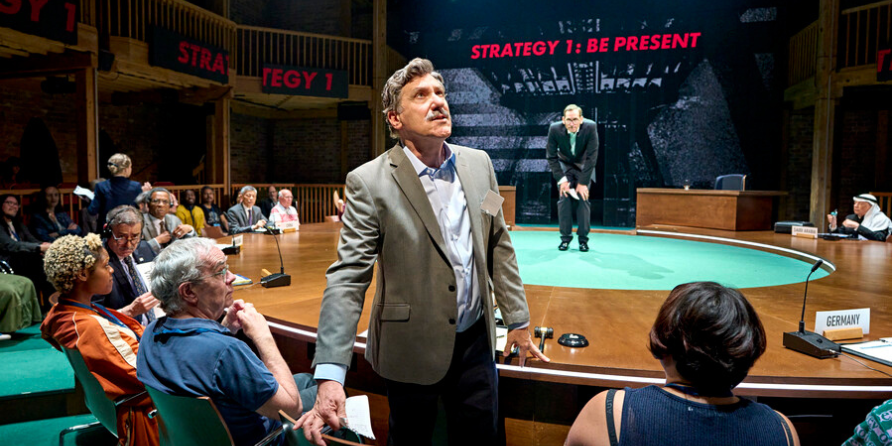 Production photo from Stratford-upon-Avon run.
But Robertson and Murphy think the story is one worth telling because it demonstrates what can happen when we are prepared to make the effort to find agreement. If it happened once, it can happen again if only we have the will and are prepared to talk and negotiate with each other. They are full of admiration for the thousands of negotiators, diplomats, scientists, and lawyers whose job it is to keep the lines of communication open and keep optimistically beavering away in the hope of reaching a lasting and transformative agreement.
The pair see Kyoto as the first play in a trilogy about the COP conferences, which, as ever, they will write together. This collaborative way of writing a play is still the exception rather than the norm in British theatre and feels particularly apt given that in Kyoto they are writing about how you come to an agreement when positions seem entrenched and polarised.
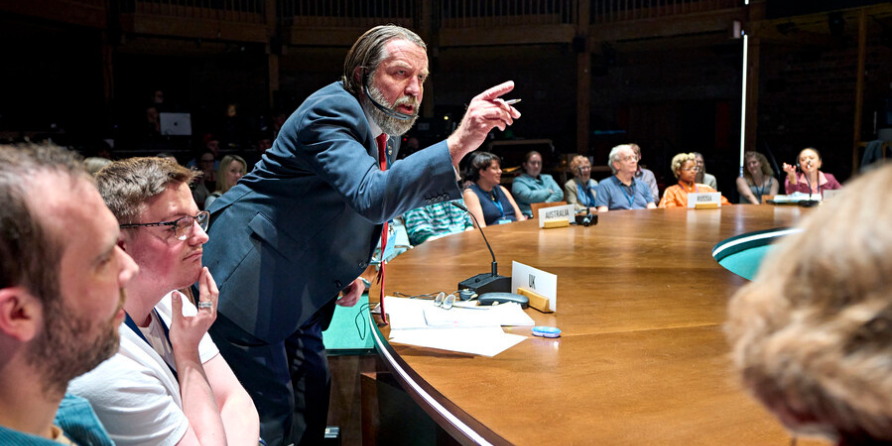 Production photo from Stratford-upon-Avon run.
“There is something that feels highly appropriate in collaborating to write Kyoto because the way we work together is one of constant negotiation, and that, of course, is the subject of the play: the difficulty of negotiation,” says Murphy.
“Yes,” says Robertson, “but also theatre itself is an act of negotiation, and we believe that when you are involved in a process that is collaborative and which takes on the ideas of so many people, including the director, the cast, and everyone else involved, then the result is better. The finished play is an act of agreement between everyone involved in the show. There are a lot of parallels between what goes on at COP and making art.”
Cover photo: Stephen Kunken (Don Pearlman) in Kyoto. Photo by Manuel Harlan during the Stratford-upon-Avon run.


