


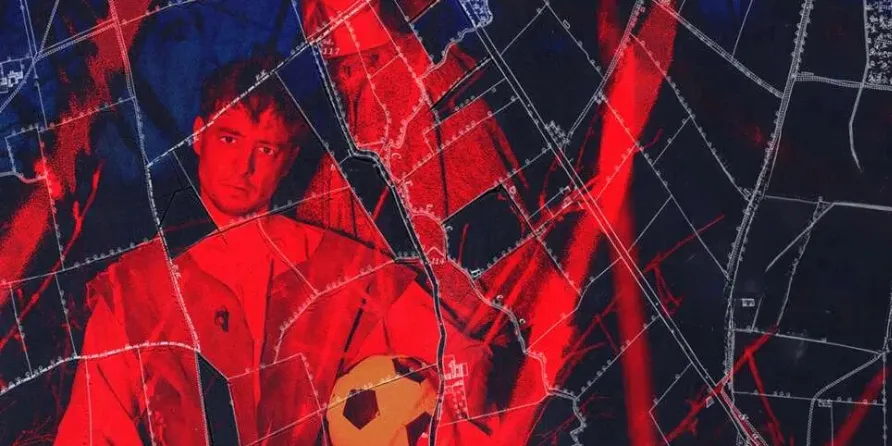
Lyn Gardner interviews Stewart Pringle as The Bounds opens at the Royal Court Theatre
“In some ways, it is an anti-London play because London so often misunderstands the North,” says Pringle before adding, “although maybe sometimes the North also misunderstands the South.”

“I don’t think you ever expect that you and your life will be part of history,” says playwright Stewart Pringle, whose play The Bounds arrives at the Royal Court this week from Live Theatre in Newcastle. It’s a play that very much reminds us that what eventually becomes written about in the history books also crashes into ordinary people’s lives, changing them, scattering them when they thought they were rooted, and blowing them hither and thither like fragile dandelion clocks in the wind. “Before COVID, we looked back on the Spanish Flu pandemic as something that had happened to other people and wouldn’t happen again. But then COVID happened to us.”
The last time that playwright Stewart Pringle and I talked, it was during the pandemic. At that time, there was much discussion in the theatre community—where all production had ceased because of lockdown—about how it was often said that it was during enforced quarantine from the plague that Shakespeare wrote that great masterpiece, King Lear.
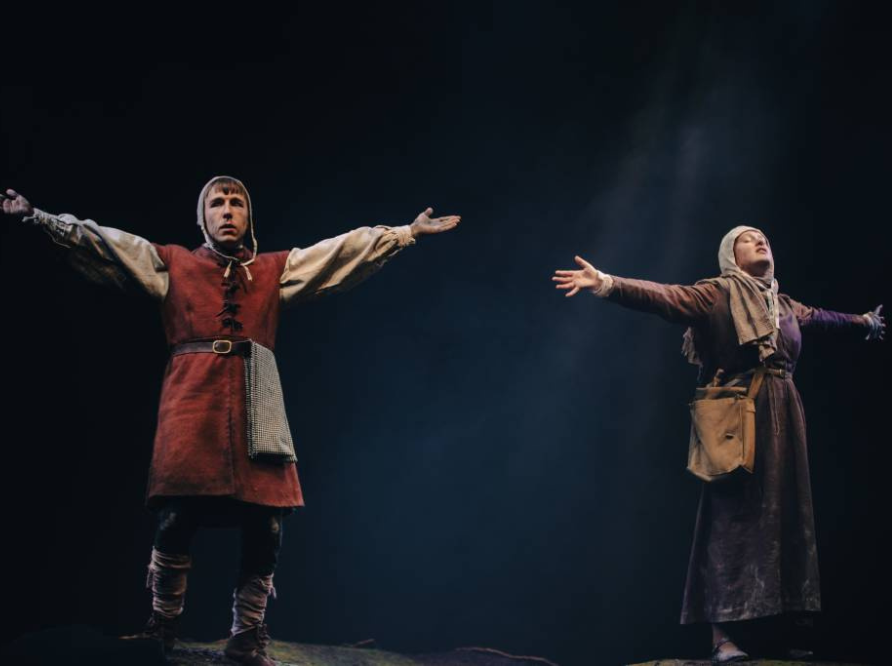 The Bounds production image.
I asked Pringle, who, in his other role as senior dramaturg at the National Theatre, is at the heart of British new writing, whether he thought lockdown would produce a contemporary King Lear. Or a great play about pandemics. He said he thought not, at least not immediately. After all, the great piece so far to emerge from 9/11 was not Neil LaBute’s 2002 play, The Mercy Seat, but the 2013 musical, Come From Away, a show written with much greater distance. But he did hope that lockdown might give some playwrights the opportunity to dream and write.
So it has proved for Pringle himself, who until now is best known for his 2017 Papatango Award-winning play, Trestle. This week, The Bounds, a play that Pringle began and abandoned in 2018 but then finished during lockdown, opens in Sloane Square, and it is a haunting and distinctively different play, eerie, earthy, and deeply layered, conceptual in scope and yet very particularly of rural Northumbria. As the play’s director, Jack McNamara, also artistic director of Live Theatre, says, “It’s a play that looks small, but it’s massive.” It is also one that comes with aftershocks and rumbles that echo right down to our own century. “It is,” continues McNamara, “a haunted play, haunted by history.” Folk memory too. Watching it, it feels as though the Northumbrian soil had somehow gotten lodged under the keypad Pringle was using to write The Bounds.
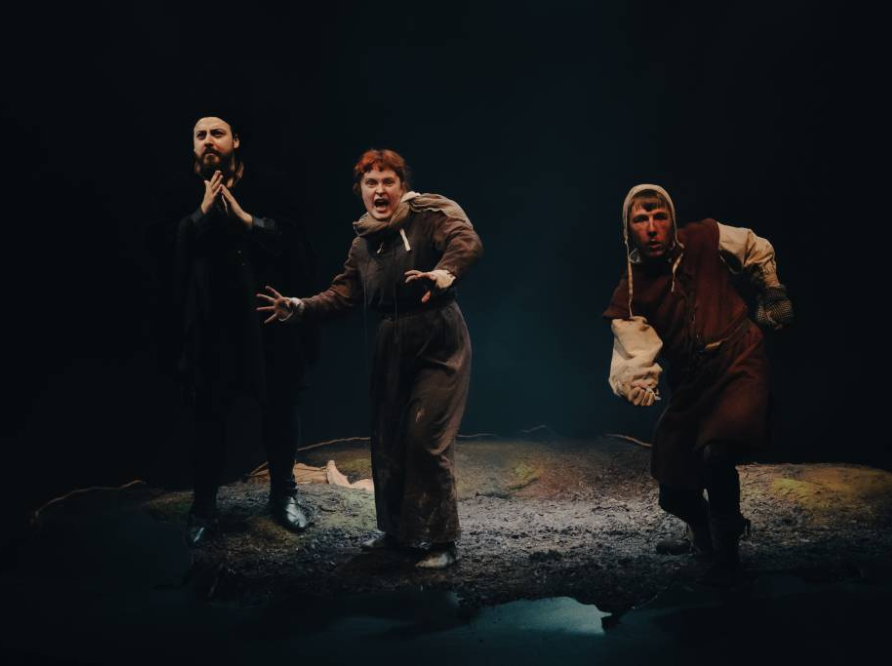 The Bounds production image.
The Bounds may not be Pringle’s King Lear, but it is an utterly fascinating piece that looks like one thing but turns out to be quite another and which is grounded in the northeast of England in the 16th century, and yet is also sharply contemporary. Oh, and it’s set during a football match—although it’s not the modern game as we know it, but a violent long-form version that took hours, sometimes days, and which was a way that neighbouring villages defined themselves and settled long-held rivalries.
“It began in 2018,” says Pringle, who was raised in Northumbria, “as an exploration of tribalism and loyalty—to place, to ideas, and to a football team.” Even if they are a bit of a shit football team, those ideas of belonging and loyalty manifest in the characters of Percy and Rowan (genuinely cracking performances from Ryan Nolan and Lauren Waine), two villagers perched on a scrap of earth at the edge of the village boundary, who are as far from the central action of the game that is playing out as they are from London, where the boy King Edward VI is enforcing the Reformation started by his father Henry VIII’s marriage to Anne Boleyn. He is making decisions that will impact Percy and Rowan’s lives. Then a stranger arrives.
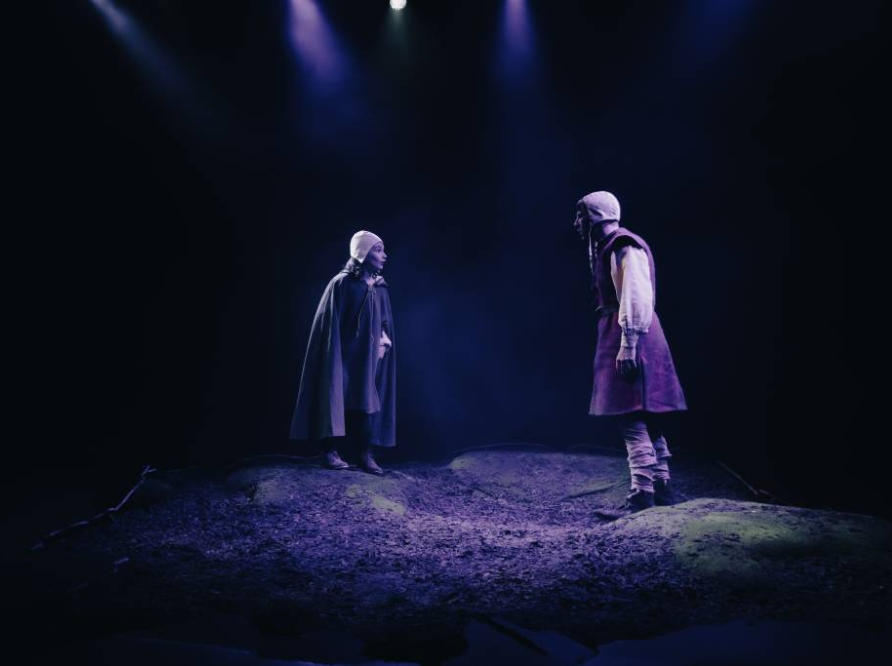 The Bounds production image.
“I think as a species, we just aren't very good at perceiving what change actually means,” says Pringle. “To a large extent, we’re animals stuck in the moment that we live in, and we're very reactive to short-term problems and short-term gains. We are bad at long-term thinking and planning ahead. But of course, when you are living through whatever era it is, it is very difficult to place yourself within a context.” He adds, “Although we're slightly inclined to always feel like we're living in a particularly bad period of time, I suspect we really are at the moment.” Indeed, things feel very fragile and scary, and we are very far from the post-war optimism of the post-World War II baby boomers who thought that the peace and growing prosperity they enjoyed would continue for their children and their children’s children.
Both Pringle and McNamara are very curious to see what London makes of a piece whose language and sense of place are so rooted in the Northeast.
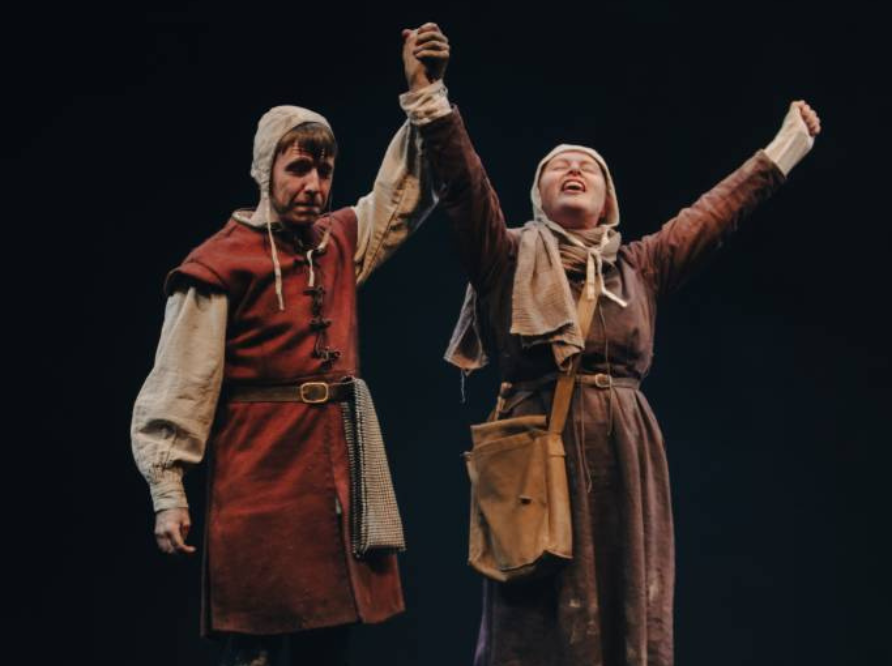 The Bounds production image.
“In some ways, it is an anti-London play because London so often misunderstands the North,” says Pringle before adding, “although maybe sometimes the North also misunderstands the South.”
McNamara argues that one of the things that drew him to The Bounds was the fact that “lots of people write plays about a particular place and put the characters in that place. But what they often don’t do is really dig down under that place, and that’s what Stewart has done so well.”
In Newcastle, the play was embraced by many—both critics and audiences—but caused puzzlement for some.
“It’s definitely not a play that is going to please everybody,” says McNamara, “but that is why it is such an interesting play, and I think that’s important, particularly at the moment. I read so many plays that seem to have been written to right the world around a particular issue. This is much more complex than that. The world is much more complex than that.”
Cover photo from The Bounds, playing at the Royal Court Theatre until 15th July 2024. Book your tickets here.


