


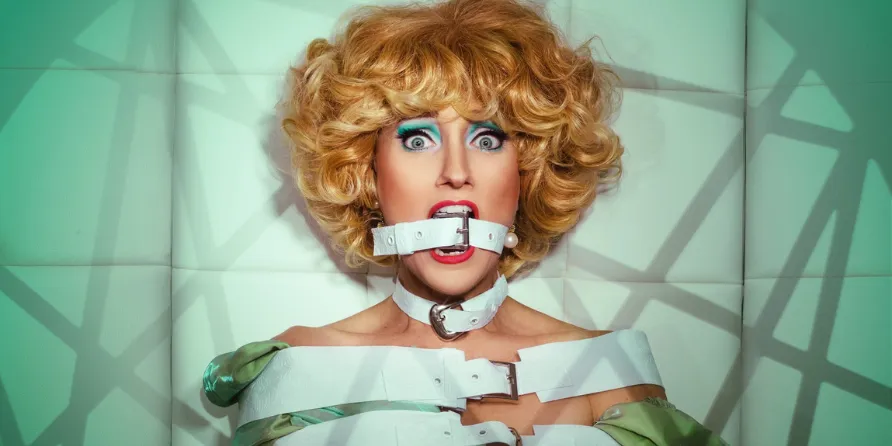
Lyn Gardner interviews Leah Shelton as Batshit comes to Soho Theatre
Leah Shelton’s daring one-woman show confronts the weaponisation of “hysteria” against women, transforming her grandmother’s silenced story into a powerful, witty reckoning.

When Australian theatre-maker Leah Shelton was growing up, she thought that her grandmother, Gwen, was quite eccentric. Gran had her own particular way of doing things. It was only when she was older that Shelton learnt that as a younger married woman, Gwen had been sent to a mental institution.
Batshit, which arrives at Soho Theatre next week, is a tribute to her grandmother but also to any woman who has ever been called 'crazy' or 'hysterical', widely used words which are often weaponised against women. A big hit at the Traverse during the 2024 Edinburgh Fringe, from its opening moments Batshit is a crazy good and stylish swipe at the pathologisation of women’s mental health. It begins with an apparently perfect 1960s housewife singing Get Happy. It features axes. But perhaps the horror is located in a different place than where you might expect.
“The trope of the crazy woman has always fascinated me,” says Shelton, pointing to how women’s behaviour and mental health are used as everyday tools to discredit women in the legal system, whether in the reporting of assault cases or custody battles, and in the doctor’s surgery, where women’s symptoms have often been dismissed as being all in their heads.
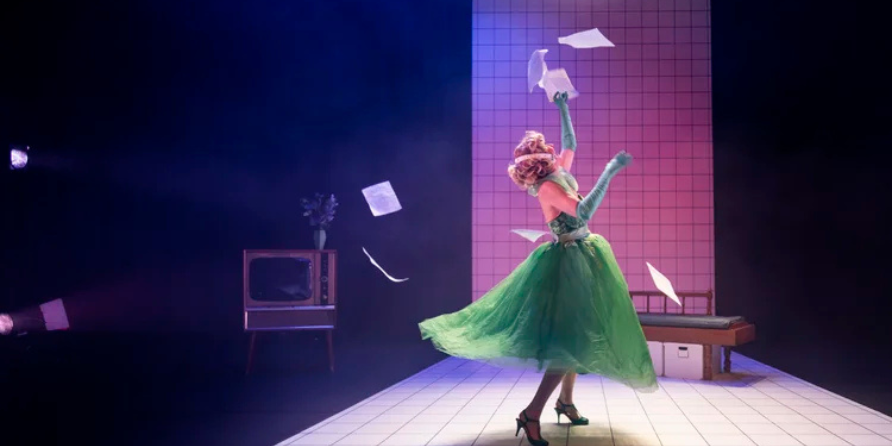 Batshit production shot from Traverse Theatre run.
When Shelton started to make Batshit, it was driven by some knowledge of her grandmother’s history but was a more generalised examination of our tendency to label women as hysterical. But it was director Ursula Martinez, whose 2009 show, A Family Outing, remains a glorious and seldom bettered example of the theatrical excavation of personal family history, who pushed Shelton to dig deeper into her grandmother’s story and try and locate medical records. However uncomfortable that may turn out to be.
“Gwen always used to say that we should look forward and we shouldn’t look back, but maybe that was because she couldn’t even name the thing she didn’t want to talk about. Her generation had a lot of taboos around relationships and feelings. So, we didn’t talk about it as a family.” As Gwen’s closest living relative, it was Shelton’s mum who applied to see the records from the mental hospital where Gwen had been incarcerated. “It was only when we received the dusty medical records that we understood more.”
The more-explored in Batshit - is that in the wake of the loss of a baby, Gwen had wanted to leave her husband and the family home, behaviour considered so outrageous for a married woman of the era that she was sent to a mental institution. There she was administered drugs and electro-convulsive shock therapy until she was deemed well enough to be returned to her role as a good wife.
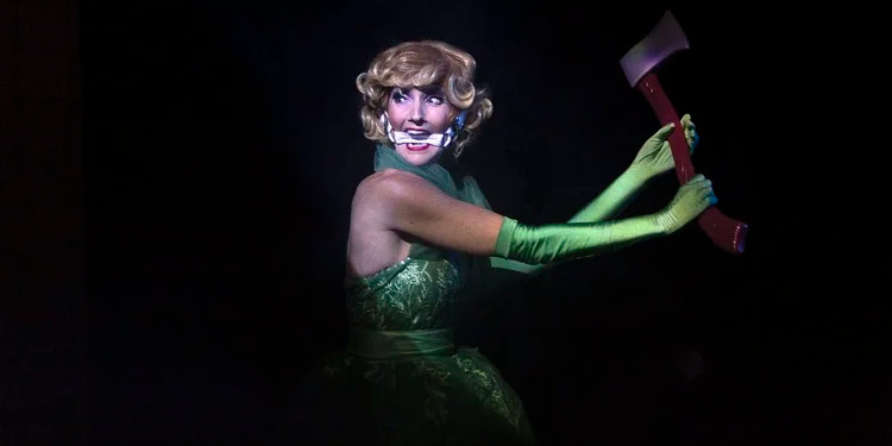 Batshit production shot from Traverse Theatre run.
“When we received the medical records, the show very much became Gwen’s story and a portal to examine how women are treated and labelled. When people come up afterwards and want to talk, and they do, it is because of that personal connection. It’s the reason why we tell stories, isn’t it, because of the human connection,” says Shelton, although she adds that “autobiography and vulnerability are not my normal comfort zone.”
“Leah was very nervous about upsetting her family,” says Martinez, “and I’m not in the game of wanting to upset anybody. But I do want to make powerful theatre, and I knew that telling that personal family story was the way to do that.”
Bringing Shelton’s mum on board was crucial. “Taking care of the story and my family was key,” recalls Shelton. “My mum was the closest connection point with Gwen, so it became obvious that I had to invite her into the rehearsal room and the process to honour her and have her consent. Her voice ended up being in the piece.”
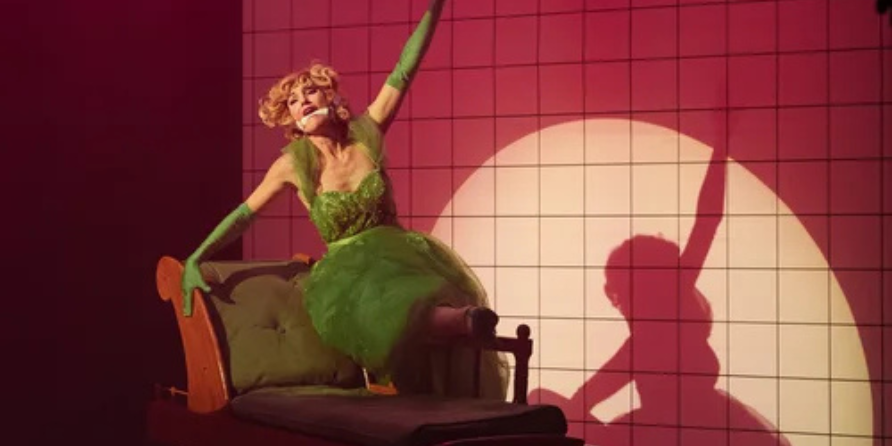 Batshit production shot from Traverse Theatre run.
It is a brilliantly put-together show, full of sizzling visual flair and delivered with the lightest of touches while simultaneously being hard-hitting and affecting. The mix of the ridiculous and the serious, documentary and cabaret, melodrama and horror is very neatly handled.
“It’s a heightened world,” explains Shelton, who designed the show herself and has done it in a way in which the visual language—that of CCTV and surveillance—offers its own potent metaphors. “I think the power of the work is that it goes from a very heightened theatricality to me just on stage reading a letter to my grandma.”
It's why after the show people often want to talk to Shelton and share their own family histories and stories of female relatives whose non-conforming behaviour was pathologised and, like Gwen, sometimes medicated. Doctors and mental health professionals too have been in touch too. “People say thank you for telling this story because it’s important to open up the conversation.”
It is. We may like to think that the incarceration of the mad woman in the attic is the stuff of Victorian novels and even dismiss Shelton’s story of her grandmother as something that happened half a century ago, but maybe we are still wedded to the idea of the hysterical woman who goes batshit and needs to be controlled.
“We use those words about women all the time; we call women crazy bitches or label them as hysterical. It is so present in the language.” But maybe Batshit can help change that. After a show at the Traverse last year, Shelton overheard a man remarking that it had made him realise that he had to stop calling women hysterical. Batshit calls time on that word, and it does it with wit and heart.
Cover image from Batshit, playing at Soho Theatre from Wed 24 to Sat 27 Sep 2025. Book your tickets today.


