


Lyn's Edinburgh Review Roundup 2024: Final Week
What has caught the attention of our resident critic during the final week of the Edinburgh Fringe?

Everyone has a story to tell, and in Edinburgh this year, it sometimes feels as if the entire world is telling their story. What often marks the success of these one-person shows is whether the teller finds a compelling format in which to share that story.
Jessica Regan does in 16 Postcodes (Pleasance Courtyard), a storytelling piece in which she has a story to tell about each of the 16 postcodes she has lived in over the last 20 years, ranging from Acton to Clapham Junction, Wimbledon to Primrose Hill. The audience gets to select some, and Walthamstow—where she currently lives, but not for long—is always included. Regan is a born storyteller, and, on the day I was there, the stories embraced a coil crisis in Greenwich to a breakup on the Holloway Road. Given the housing crisis in London, it’s a shame that the show doesn’t investigate that more fully, only alluding to it in its closing moments. But 16 Postcodes is a neat device, neatly handled.
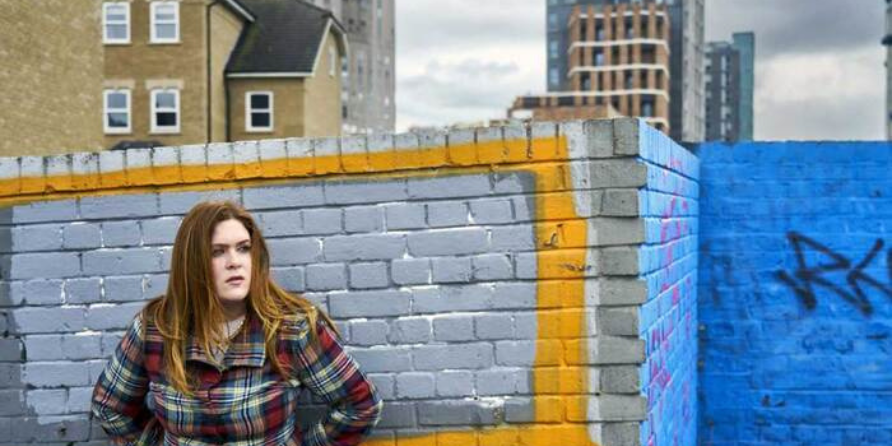 16 Postcodes, playing at Summerhall. Photo by David Emery.
Place is also crucial in Katie Hurley’s You're SO F**king Croydon! (Underbelly). Hurley uses David Bowie’s crushing putdown to explore her relationship with the place where she grew up. In the space of 60 minutes, she plays cleverly with perceptions and has a lot of fun doing it with audience participation, some sharp observations from a working-class perspective, and suggesting that while you can take the girl out of Croydon, it takes more than a year travelling to take Croydon out of the girl. “Only Croydonites are allowed to slag it off,” says Hurley. She does, but with affection.
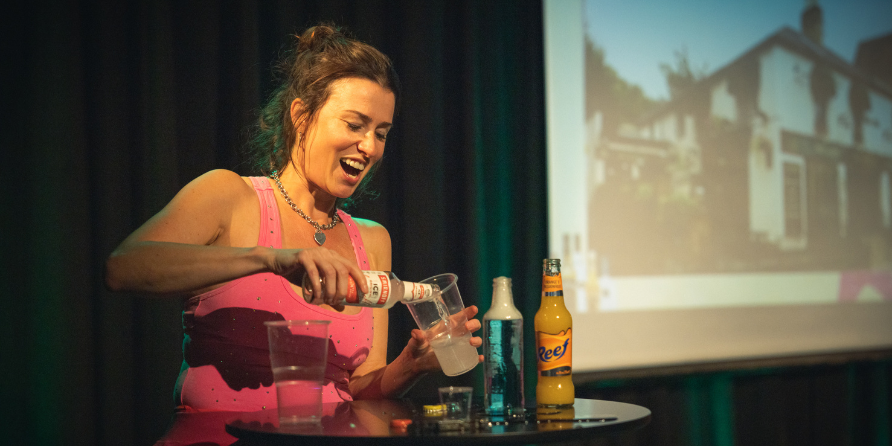 You're SO F**king Croydon, playing at the Underbelly. Photo by Glenn Foster.
North London is the setting for REVENGE: After the Levoyah (Summerhall), set in 2018, when the papers were full of stories about the Labour Party and antisemitism under its then leader, Jeremy Corbyn. The Jewish community feels under siege, and Lauren and Dan’s Nan is so scared she won’t leave the house. When Grandad dies and the boiler breaks down, a set of wildly improbable events unfold in a show that is always intelligent and consistently goes places that are darkly unexpected. This show is like keeping plates spinning in the air, and writer Nick Cassenbaum, director Emma Jude Harris, and actors Dylan Corbett-Bader and Gemma Barnett keep them aloft. Expertly.
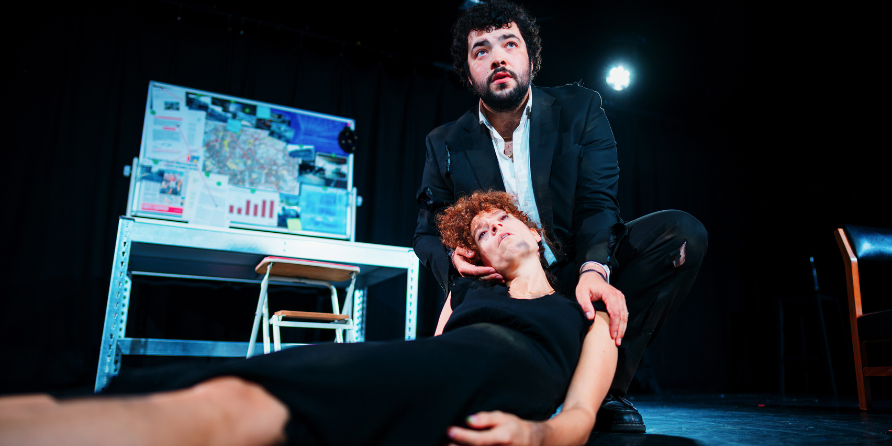 REVENGE: After the Levoyah, playing at Summerhall. Photo by Alex Brenner.
Phoebe Ladenburg is terrific too in Surrender (Summerhall), a solo show written by Sophie Swithinbank about a woman talking to the 12-year-old daughter she hasn’t seen since she was imprisoned. Quite for what reason, it is only gradually revealed. The woman is an actor, good at making things up, and Swithinbank’s twisty script is clever in the way it gradually reveals her to us as unreliable and emotionally manipulative but also clearly suffering from mental health issues. Ladenburg’s success is in ensuring she wins our sympathy.
It is an interesting show to see alongside another exploration of maternal failures, Anna Morris' outstanding Son of a Bitch (Summerhall), a show which drip-feeds information so cleverly that you are constantly blind-sided. Another one-woman show of note is Harriet Madeley’s Outpatient (Summerhall), the story of self-absorbed and breathtakingly egocentric journalist Olive, who sets out to win prizes for a ground-breaking (and tone deaf) piece interviewing people who are dying, only to discover that she has a life-limiting incurable illness herself.
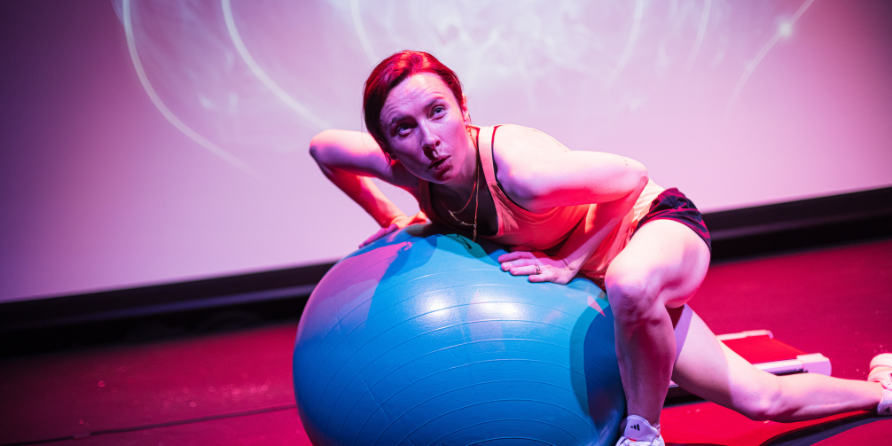 Outpatient, playing at Summerhall. Photo by Harry Elletson.
Olive is not exactly sympathetic, and of course her attempts to outrun death only prove that it can’t be done—we are all dying whether we have been diagnosed with an illness or not. But it’s an intelligent, wryly funny piece, and while Olive may not entirely win our sympathy, there’s some nice observational comedy, particularly around Olive’s partner, Tess, a war reporter, who goes into full battle mode against Olive’s illness.
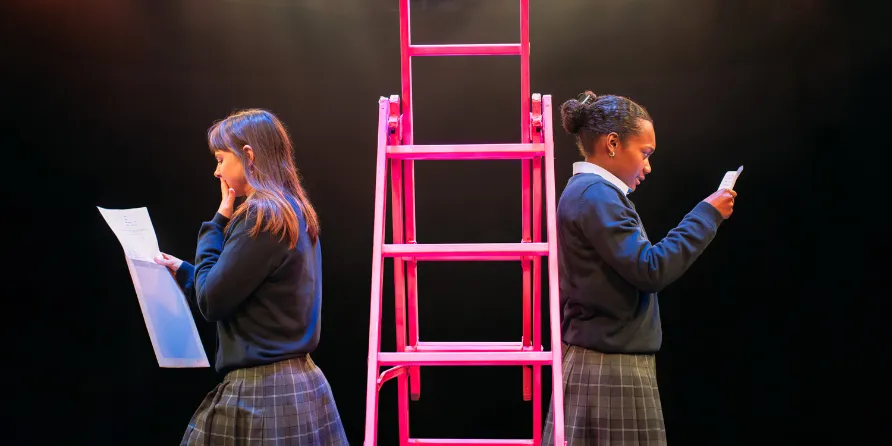
More new writing you should pay attention to includes Playfight (Roundabout @ Summerhall) by Julia Grogan, who is part of Dirty Hare, who created the brilliant Gunter. Following three young women over 10 years as they meet beneath a tree and share intimacies, experiences, and unexpected feelings, it’s a coming-of-age tale, and in that respect, it feels part of an overworked genre. But it is written with a rumbustious energy, and yet it is also as delicate as butterfly wings. Grogan is clearly a fierce, unstoppable talent.
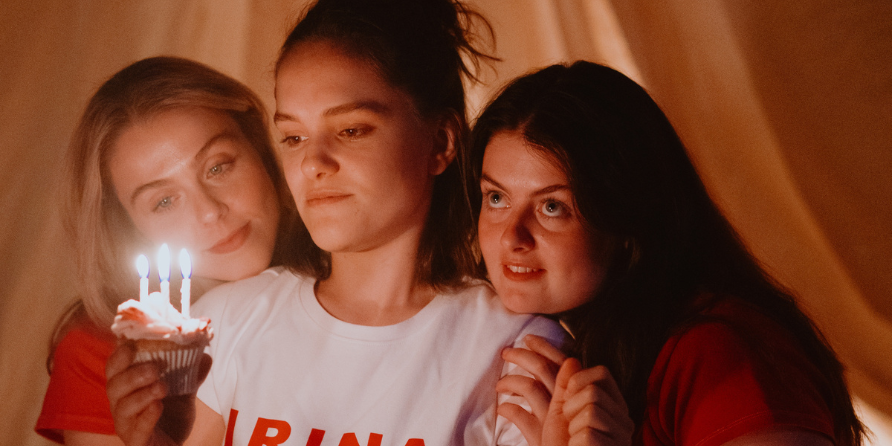 Sisters Three, playing at Summerhall. Photo by Giulia Ferrando.
TheatreGoose is also clearly a young company worth watching. I missed their well-received debut, Her Green Hell, last year. But Sisters Three is ingenious, giving Chekhov’s disappointed siblings Olga, Masha, and Irina the opportunity to reinvent the narrative provided by the Russian playwright by delving into a magical dressing-up box that provides different opportunities to try out different identities, from the Gorgons to Macbeth’s Three Witches to the Sugarbabes. It makes some smart points along the way about how women are boxed away, and if it sometimes feels like literary criticism rather than fully fledged drama, it’s intelligent stuff and performed with verve.
In L’Addition (Summerhall) and then going to Battersea Arts Centre in the autumn, Bertrand Lesca and Nasi Voutros play a waiter and a customer who are trapped in a scenario that they are unable to break, even though it ends in disaster every single time. Even when the pair keep swapping roles. They learn nothing from their own or each other’s experiences. Whether it is the waiter or the customer, the outcome is always the same. Lesca and Voutros are brilliant clowns, and the show is both obvious but also subtle in the way it suggests we are doomed to repeat ourselves with tragedy and farce, following each other in an unbreakable cycle.
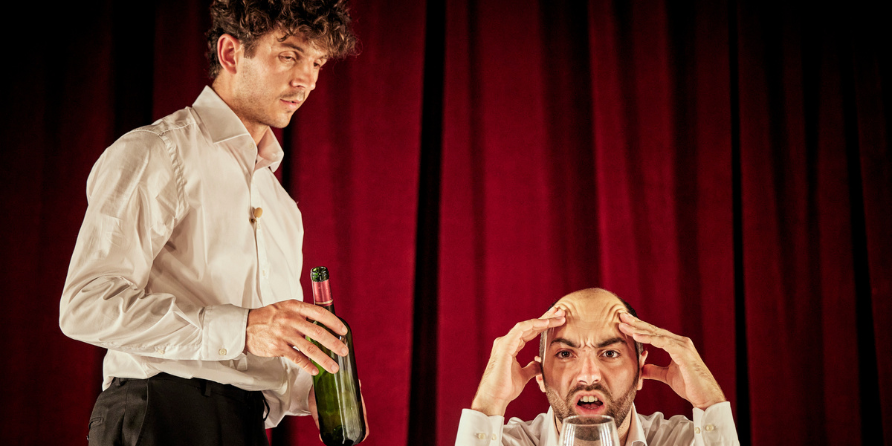 L’Addition playing at Summerhall. Photo by Christophe Raynaud de Lage.
L’Addition is part of the Here and Now showcase, which also includes Testo, a piece by Wet Mess that operates on the fringes of drag, dance, and performance art. There are some astonishing moments, not least when the artist demonstrates what it is like to be in a different skin, and if the piece sometimes feels like a piece of performance art from the early 2000s, it also succeeds in being both monumental and fragile at the same time.
Louise Orwin has been making performance art for over 10 years. But she has never hit the big time. Audiences have been small, and the financial recompense is low. So, she’s taking a different approach. She has studied what gets likes on TikTok, and she is copying that to make a show called FAMEHUNGRY that is live streamed at Summerhall every day. The ambition is to get over 20,000 likes before the end of the show. Artists make content, and so do successful TikTokers. What’s the difference? Could it be less than we might like to think? That’s just one of the questions Orwin raises in a show that is frenetic and uncomfortable to watch but also so compelling you can’t look away. Particularly from the online comments. It is cleverly constructed so that you leave feeling stuffed to bursting but strangely empty.
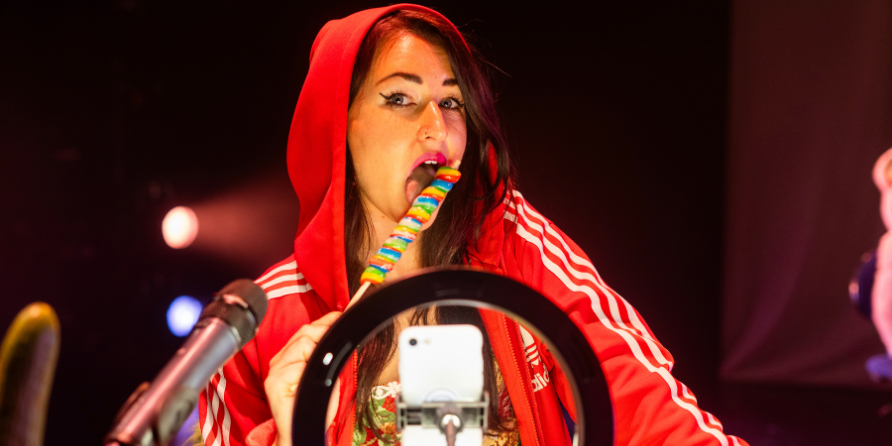 FAMEHUNGRY, playing at Summerhall. Photo by Clemence Rebourg.
Worklight Theatre’s It's the Economy, Stupid! (Pleasance Dome) is a smart example of how you can weave a personal story into a much wider tapestry. Shortly after Joe Sellman-Leava was born, his parents went bankrupt, and their small greengrocer was hit by the early 1990s recession and the rise of supermarkets. His family story is entwined with a crash course in economics, which begins with Sellman-Leava’s early experience with inflation when buying the Beano and covers supply and demand and why young people today can’t get on the housing ladder. It has nothing to do with buying too much coffee. This is smart stuff—theatre with a purpose that is always very entertaining.
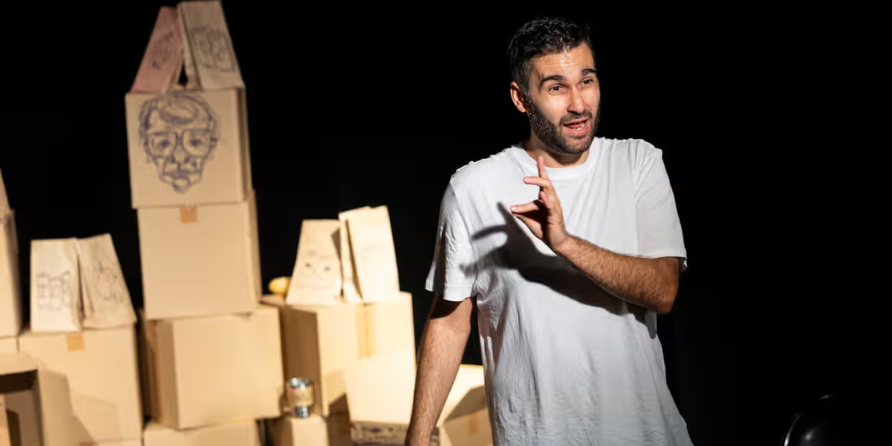 It's the Economy, Stupid! playing at the Pleasance Dome. Photo by Duncan McGlynn.
I was entertained too by Wes Peden’s Rollercoaster (Assembly Roxy), a deftly put-together show that uses Peden’s exceptional juggling expertise to celebrate and create some of the exhilaration of the rollercoaster. You're Needy (sounds frustrating) is notable for being offsite (but booked via Summerhall), taking place in the bathroom of an upstairs tenement block. Here on a one-to-one basis, you meet Carrie, who has retreated to the bathroom in the same way that some young Japanese people take up permanent residence in their bedrooms, a phenomenon known as hikikomori. Produced by Irish company tasteinyourmouth, it’s a good idea and beautifully presented, but it doesn’t delve much below the waterline as it explores how the wellness industry ensnares young people.
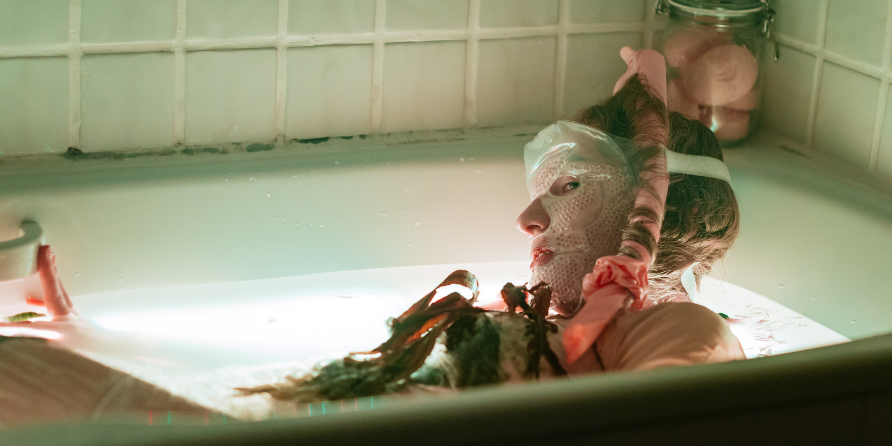 You're Needy (sounds frustrating), booked via Summerhall. Photo by Simon Lazews.
Wellness and a much depleted and cash-strapped NHS’s inability to support the increasing numbers of people living with mental health crises are dealt with with grace, humour, and compassion in Jonny & the Baptists: The Happiness Index (Assembly George Square Gardens). It’s a seriously funny piece whose celebration of friendship is guaranteed to send you back on the street feeling uplifted.
Cover photo by Mihaela Bodlovic from Playfight, playing at Roundabout @ Summerhall. The Edinburgh Festival Fringe runs until the 26th of August. For the full programme visit here.


