


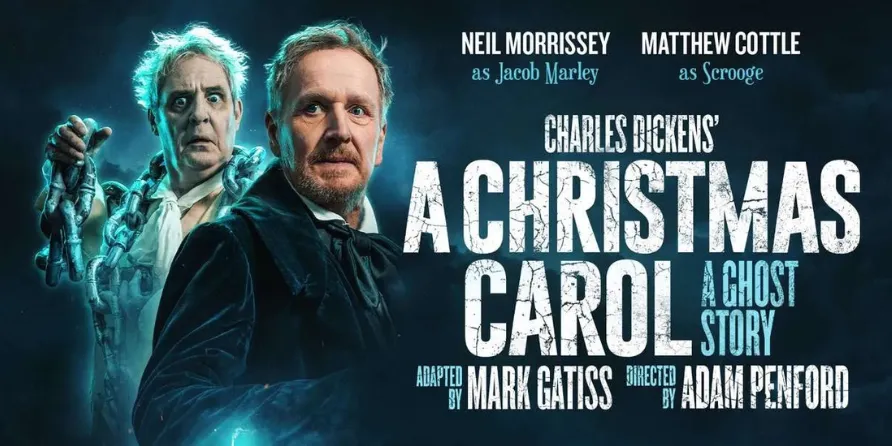
Lyn Gardner Talks to Matthew Cottle About Stepping into Scrooge’s Shoes at Alexandra Palace
Inside the haunting power of A Christmas Carol and the enduring pull of Dickens’ ghosts.

We would all like to think that 21st-century London is vastly different from the Victorian city depicted by Charles Dickens in A Christmas Carol, but we are probably kidding ourselves. Hence perhaps the continued popularity of stage versions of the 1843 novella, which Dickens himself delivered regularly on stage as a solo turn.
A Christmas Carol allows us to have our (Christmas) cake and eat it because while we are all well aware of the wealth divide in present-day London, a great stage version allows us to feel the rage but also reminds us that redemption is possible through action.
“We are all capable of being selfish at times, uncaring and thoughtless, and Scrooge is an extreme example of that, but he goes on an enormous journey and does see the light,” says Matthew Cottle, who plays Ebenezer Scrooge at Alexandra Palace this Christmas in a production in which Neil Morrissey plays Jacob Marley, who is not quite as “dead as a doornail”, at least not initially. “I think it adds an extra layer to the story because we see Marley and Scrooge working together before Marley dies from a massive heart attack.”
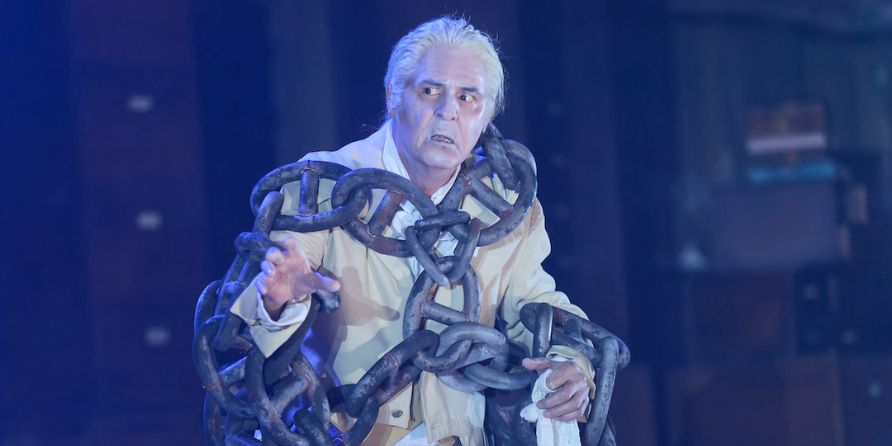 A Christmas Carol: A Ghost Story production shot. Photo by Mark Douet.
Cottle argues that A Christmas Carol endures and Gatiss's version works because “we send audiences out feeling that they can be kinder and feeling they can act on that feeling,” argues Cottle, who also played the role in this version of A Christmas Carol: A Ghost Story at Birmingham Rep last year. “It’s a story about change which changes the audience as they watch it. I felt that from the audience in Birmingham, who were wonderful.”
It’s that uplifting idea that maybe we are all capable of being a better version of ourselves and that we are all to some degree Scrooges but all capable of redemption, which perhaps explains the continued popularity and power of A Christmas Carol. This festive season, A Christmas Carol: A Ghost Story is enjoying a second outing at Ally Pally, but it is not the only Carol in town.
The Old Vic’s glorious version written by Jack Thorne and directed by Matthew Warchus, now in its ninth consecutive year in The Cut, has Paul Hilton (so good in The Inheritance) playing a Scrooge who Thorne depicts as a hurt and frightened child emotionally deformed by his childhood experiences and his debt-ridden father’s attitudes towards money and him.
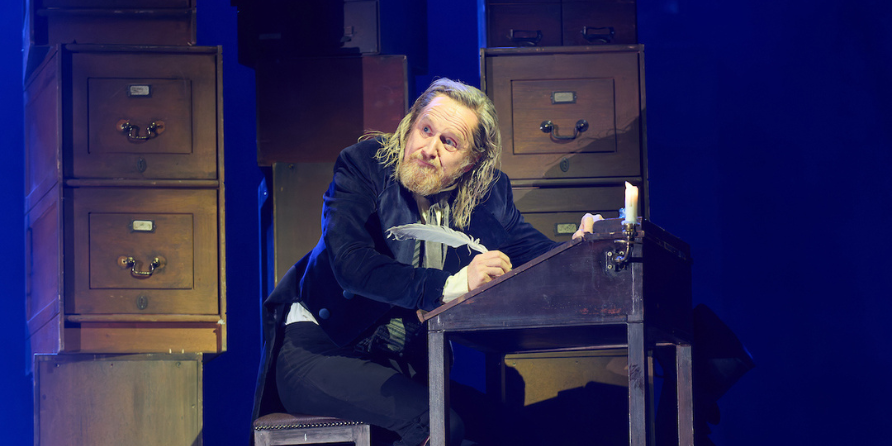 A Christmas Carol: A Ghost Story production shot. Photo by Mark Douet.
If you are looking for a few more laughs, then A Christmas Carol Goes Wrong at the Apollo, from the team behind The Play That Goes Wrong, should hit the spot. After all, the Muppet movie version succeeds in offering both humour and heart, so why shouldn’t the Mischief team?
But if you are looking for genuine spookiness, then Mark Gatiss’ A Christmas Carol: A Ghost Story is the version which plays very cleverly on the original’s ghostly antecedents. Gatiss, well known for Sherlock and of course his annual BBC ghost story, has been haunted by the Dickens tale since he saw the movie version with Albert Finney as Scrooge when he was very young.
“It’s quite scary, in a very theatrical way,” says Cottle, who points to the fact that Alexandra Palace, a place of shadows, exuding its own unique atmosphere and febrile ghosts, is the perfect setting. He argues that the Gatiss version captures the bleakness of the original to good effect, emphasising the ghostly intent of Dickens with clever illusions and projections to excellent creepy effect. There are skeletal puppets, crepuscular lighting and some scary surprises.
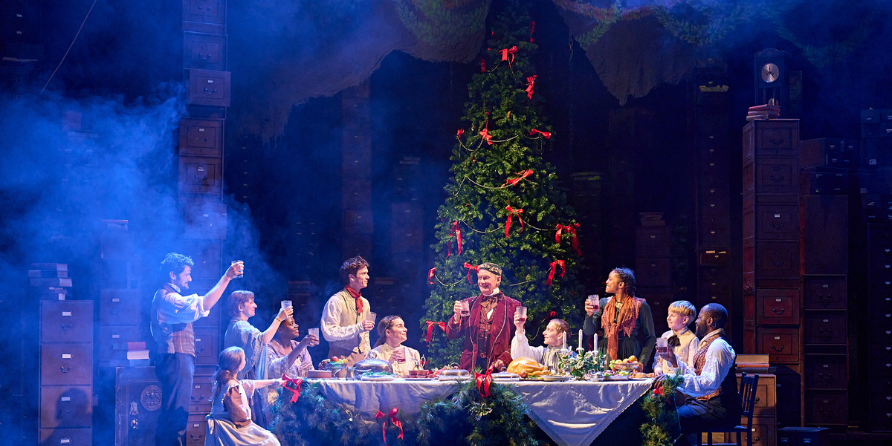 A Christmas Carol: A Ghost Story production shot. Photo by Mark Douet.
Scrooge has sometimes been reduced in the theatre to a two-dimensional figure who simply goes around muttering “bah, humbug” and being harassed by clanking, unconvincing ghosts. But modern depictions, including the Jack Thorne and Mark Gatiss adaptations, offer a far more complex and psychologically compelling character which chimes with modern sensibilities and makes the role far more challenging and rewarding to play.
“It really is full on,” says Cottle, “because you don’t leave the stage the entire performance, and Scrooge goes on an enormous journey from being closed off and uncaring to someone who is pleading for his life and becomes frightened and vulnerable and through that finds his kindness and compassion. It’s exhausting to play him because it’s the full arc. But it’s wonderful too because he is a lucky man who gets a second chance. Who wouldn’t want that?”
Cover photo from A Christmas Carol: A Ghost Story. Head to our Christmas page to browse and book tickets for all festive shows, including all three versions of A Christmas Carol.


